

Indian Wedding Photographer in Thailand: Finding The Right Team
Indian Wedding Photographer in Thailand: At A Glance
Q: Can I have a traditional Indian wedding in Thailand?
A: Yes, fully. Thailand’s luxury villa estates and five-star beach resorts particularly in Phuket, Koh Samui and Koh Samui’s private islands accommodate mandap installations, havan and sacred fire ceremonies, multi-day programme formats and South Asian catering. Several properties have specific experience with Hindu, Sikh and Muslim Indian wedding formats. The symbolic ceremony route (marrying legally at home, celebrating in Thailand) is the most common approach for international Indian couples and gives complete creative freedom over venue, ritual and timing.
Q: What should an Indian wedding photographer in Thailand know that a general photographer doesn’t?
A: The specific visual language and emotional rhythm of Indian wedding rituals from the intimacy of the Haldi, the fast chaos of the Baraat and the precise moment of the Pheras to the different light demands of a dawn Muhurtham versus a late-night Sangeet. Indian weddings are not one event, they are four to six distinct functions across multiple days, each requiring different technical preparation and a different intuitive approach. A general destination photographer is underprepared for this. An experienced Indian wedding photographer in Thailand has shot these specific ceremonies many times and knows what they are looking for before it happens.
Q: Which part of Thailand is best for an Indian destination wedding?
A: Phuket leads for large-scale South Asian celebrations; its private villa estates (Trisara, Amanpuri, Villa Aye) offer outdoor ceremony space, mandap permission and accommodation flexibility at scale. Koh Samui suits more intimate celebrations and offers a quieter, more personal atmosphere; the Conrad and Cape Fahn Hotel are standout properties. Bangkok works for very large celebrations (200+ guests) requiring five-star hotel ballroom infrastructure. A capable Indian wedding photographer in Thailand will be well equipped to sheet these weddings.
Q: How many days does a typical Indian wedding in Thailand last?
A: Most Indian destination weddings in Thailand run across three to five days. A common programme covers: Mehndi evening (Day 1), Haldi and Sangeet (Day 2), Wedding ceremony and Reception (Day 3), and optionally a post-wedding brunch or boat trip (Day 4). The photographer needs to cover all of these as a single coherent narrative, not as separate events, which is why multi-day programme experience is the single most important thing to look for when choosing an Indian wedding photographer in Thailand.
Q: How much does an Indian wedding photographer in Thailand cost?
A: For an experienced documentary photographer who understands Indian wedding ceremonies, expect THB 150,000–400,000+ (approximately £3,500–£9,300+) for full multi-day coverage. Full-service media production, including photography and cinematic film across three to five days, runs THB 350,000–800,000+ (approximately £8,100–£18,600+) depending on team size and programme scope.
Q: Do I need a Hindu priest in Thailand for my wedding?
A: Most Indian couples bring their own pandit from India or the UK; this is by far the most common approach and ensures cultural and linguistic familiarity. Thailand-based Hindu priests exist but are limited in number and regional tradition specialisation. Budget for the pandit’s flights, accommodation and dakshina as part of your wedding budget. Your wedding planner should manage the logistics. For Sikh weddings, a Granthi from a Thai Gurdwara (there are established Gurdwaras in Bangkok and Phuket) is an option, or couples travel with their own Granthi.
Indian Wedding Photographer in Thailand: Why This Is One of the Most Visually Extraordinary Combinations on Earth
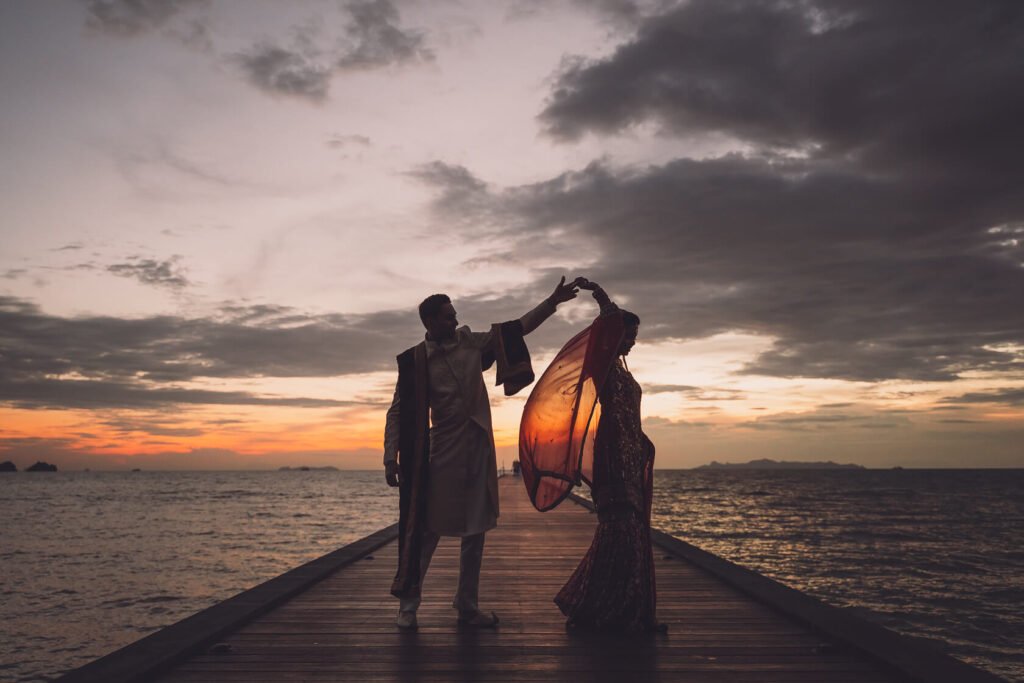
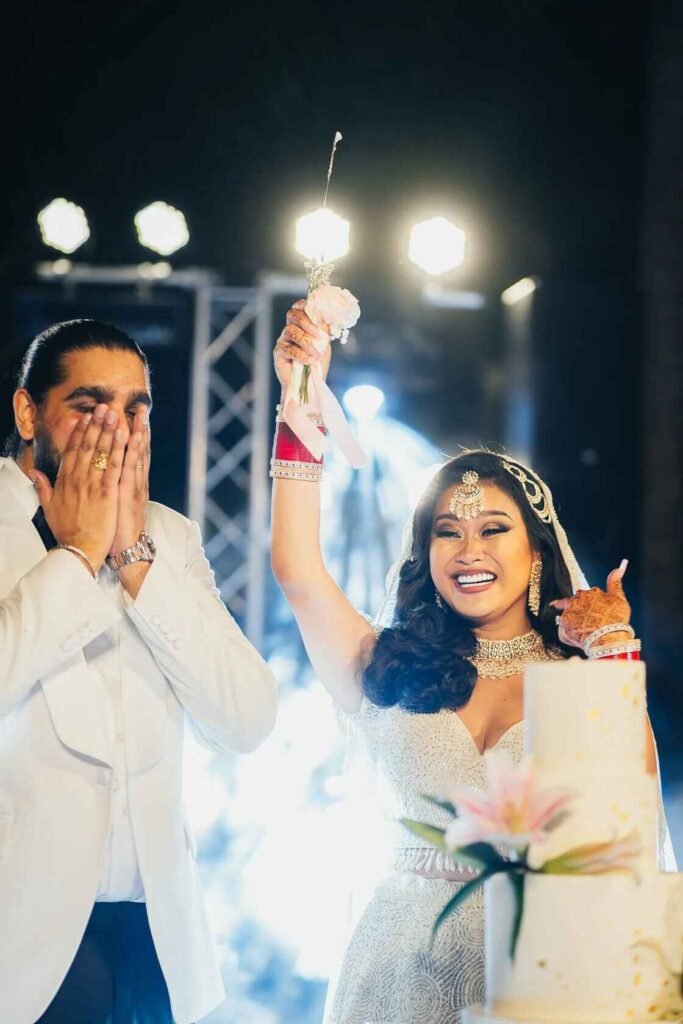
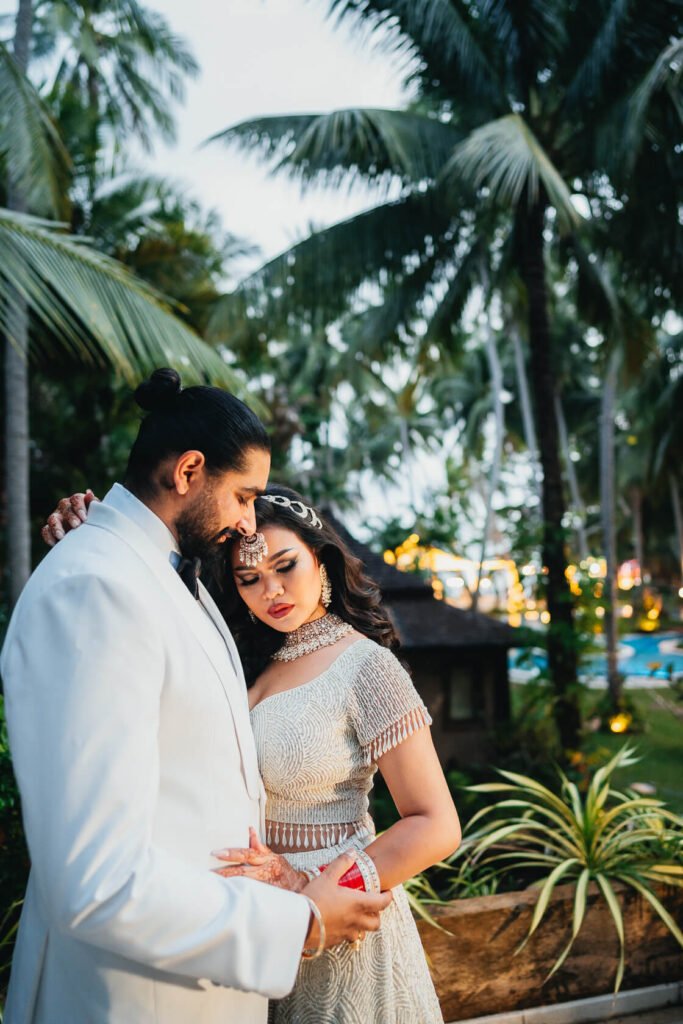
There is a frame we return to every time we discuss Indian weddings in Thailand. A bride in a deep magenta lehenga, gold running through every thread, standing at the edge of a Phuket villa terrace as the Andaman Sea turns copper behind her. The contrast of the density and warmth of Indian bridal colour against the tropical clarity of a Thai sky is not something you manufacture. It is what happens when two extraordinary visual cultures meet at the perfect place.
India produces the world’s most colour-saturated, ritually complex, emotionally layered celebrations. Thailand provides some of the finest natural backdrops and private venue estates in Southeast Asia. When the two come together, with the right photographer, the right planning and the right understanding of what both cultures bring, the result is genuinely unforgettable.
At In The Fable Cameraworks, we are a full-service wedding media production company specialising in documentary and editorial photography and film for Indian, South Asian and multicultural weddings. We have covered Hindu ceremonies in Phuket, Sikh celebrations in Koh Samui, North Indian multi-day weddings at Thai villa estates and interfaith celebrations in Bangkok. What we have learned, across all of them, is that Indian weddings in Thailand require a very specific kind of photographer and that getting this right makes all the difference.
What We Shoot: Ceremony by Ceremony
Here is what we shoot as an Indian wedding photographer in Thailand, ceremony by ceremony:
Mehndi
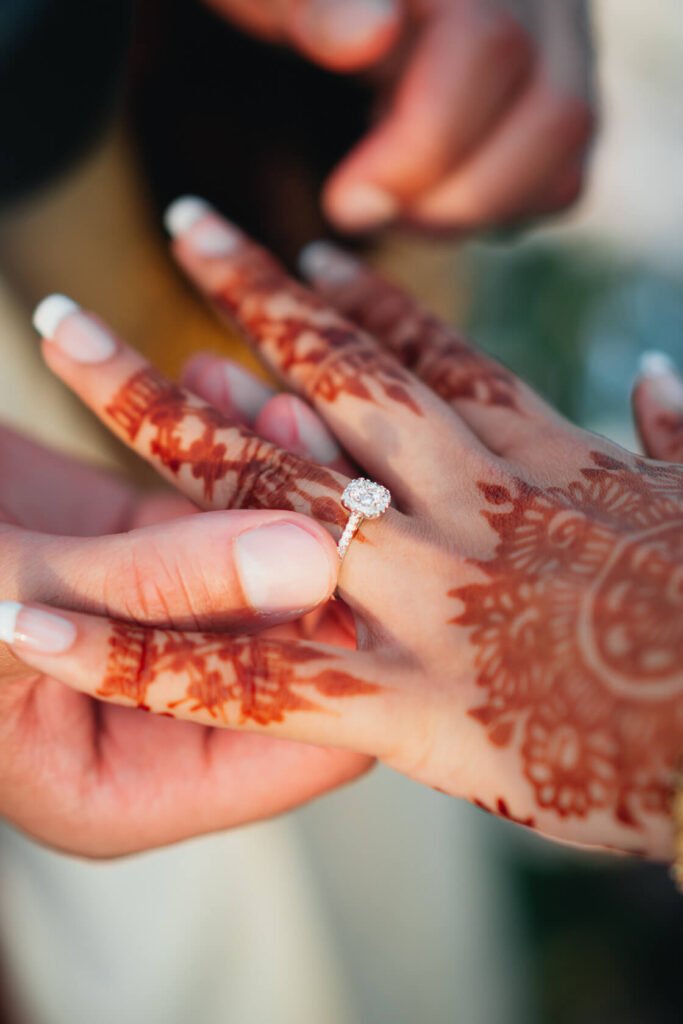
Slow, intimate, women-led. The light is typically afternoon or early evening, warm but directional. The photographer needs to be invisible, moving through the gathering without directing it, finding the hands, the laughter, the women watching each other. We work small (one photographer, no flash) during Mehndi. The images should feel like documentary portraiture, not styled shoots as candid shots look best here.
Haldi
Fast, physically chaotic, emotionally rich. Turmeric in strong daylight is technically demanding; the yellow tones require specific colour grading care. You will be covering in haldi. We are not precious about this; it is one of the most visually joyful ceremonies we shoot and we plan for it specifically.
Sangeet
High energy, low light, movement, family performances. The challenge is mixed artificial lighting and fast-moving subjects in a room that is often not configured for photography. We use fast primes, shoot available light and look for the emotional counterpoints (the couple watching a sibling perform, the grandparents at the edge of the floor and the friends’ performing their happy dances).
Baraat
The logistically most demanding function. The groom’s procession is moving, loud, unpredictable and often navigating a narrow villa driveway or resort path. We position a second photographer ahead of the procession while the lead works within it. We brief the baraat route and timing in advance. We look for the moments that happen in the gaps; between the dhol beats, in the faces of the family watching.
Pheras – Must be Precisely Captured by an Indian Wedding Photographer in Thailand
The most sacred and the most technically unforgiving. In direct sunlight at a precise muhurtham time, the ceremony moves faster than most Western photographers expect. The Jai Mala, the Saat Phere, the Sindoor; each has a specific visual moment that cannot be restaged. A photographer who has shot these ceremonies repeatedly knows what is coming before it arrives.
Reception
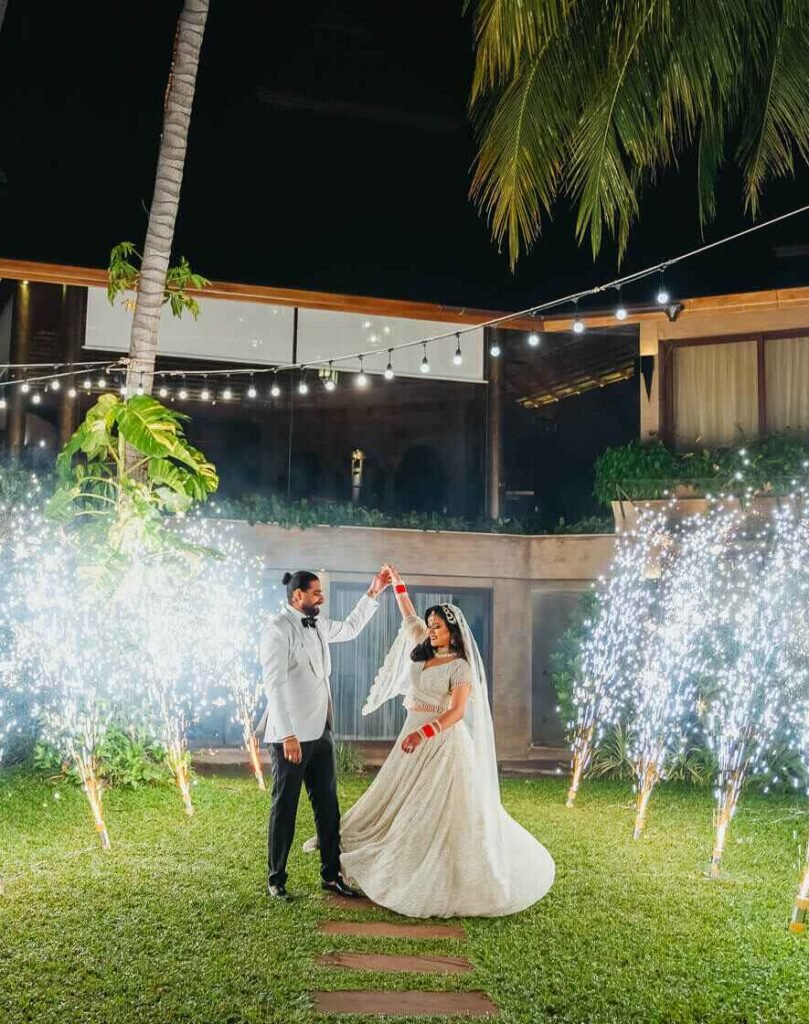
Late evening, often extending past midnight in Thailand’s tropical warmth. The energy shift from the sacred to the celebratory is one of the most interesting photographic transitions in any Indian wedding. We plan for this specifically by changing our approach, our equipment configuration and our creative lens to match what the evening requires.
Portraits & Group Photography
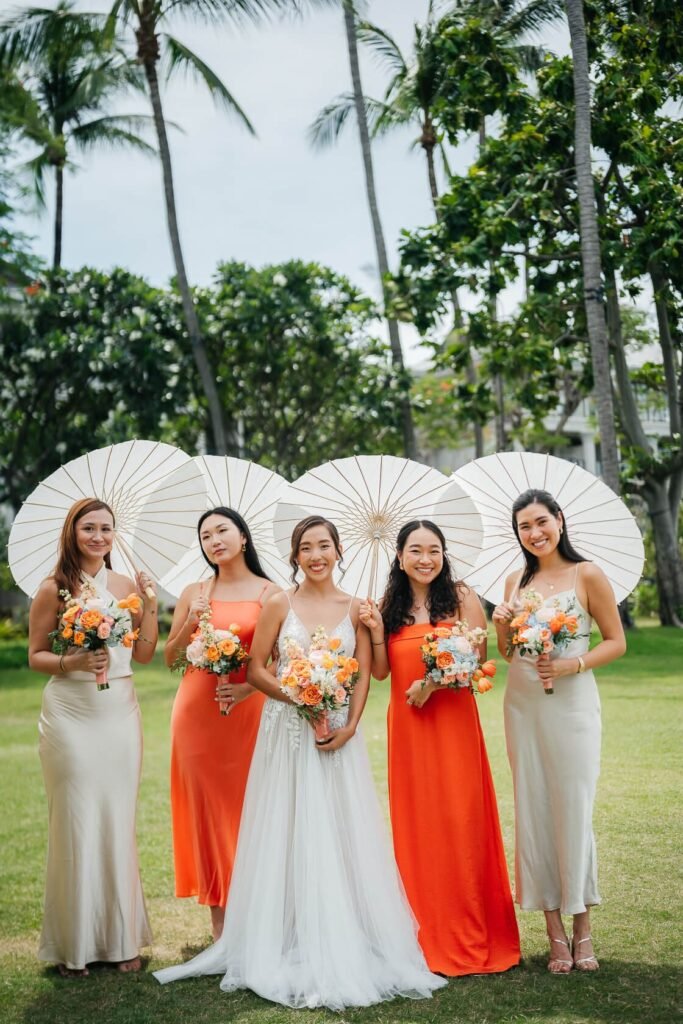
We work with pre-planned ideas and spontaneous ones to curate a gallery of editorial-style portraits and group photographs you’ll be excited to share with your loved ones. This requires an on-site creative director alongside a creative team.
Hindu, Sikh, Muslim and Interfaith Weddings: We Master the Difference
Hindu Weddings
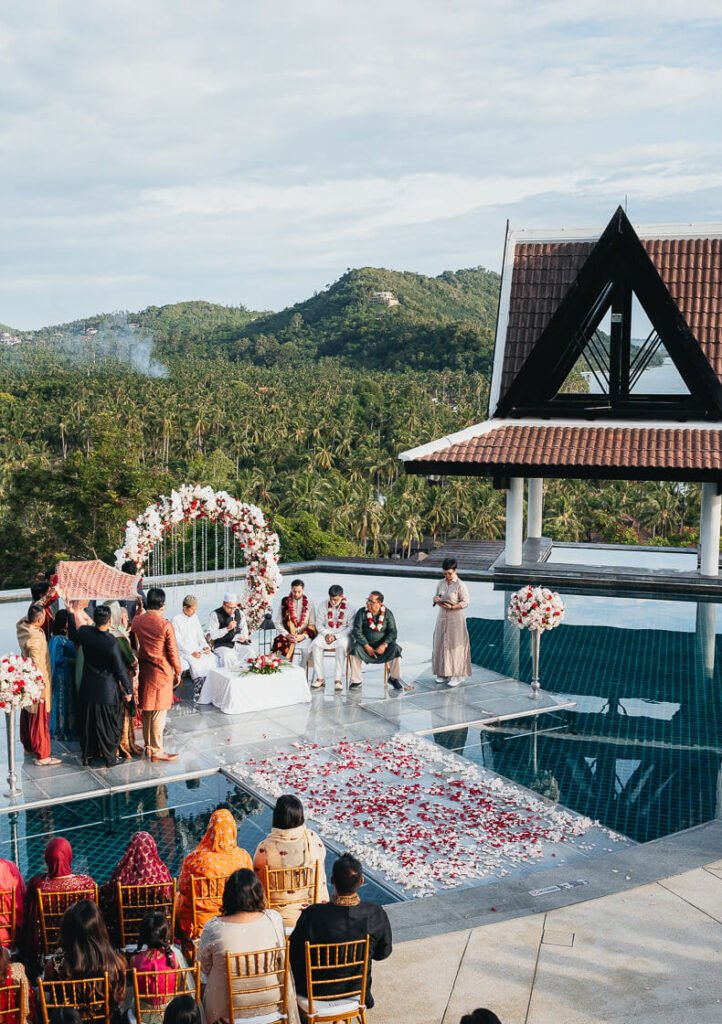
The visual palette of red and gold, marigold, jasmine and diyas photographs magnificently against Thailand’s tropical backdrop. Key requirements: mandap installation (confirm dimensions with venue in advance), havan and sacred fire (outdoor space and fire safety compliance in writing from the venue), and muhurtham timing which may be dawn (5–7am) or mid-morning. We structure the shooting day from the muhurtham outward.
South Indian weddings deserve specific mention. The Tamil Oonjal, the Kashi Yatra, the dawn ceremony format, have a completely different visual language from North Indian celebrations. From white and gold palettes, banana leaf and jasmine elements, the Nadaswaram — these require different compositional instincts. We know them.
Sikh Weddings
The Anand Karaj requires the presence of the Sri Guru Granth Sahib Ji and a qualified Granthi. Established Gurdwaras operate in Bangkok (Sri Guru Singh Sabha, Bang Rak) and Phuket. Most Sikh couples combine the Anand Karaj at the Gurdwara with a resort or villa reception. Photography inside the Gurdwara: we cover head, observe the protocols during Ardaas, work with natural light. These are not reminders we need. This is how we work.
Muslim Indian Weddings
The Nikah is typically conducted privately with an Islamic scholar. The Mehndi and Walima reception at a Thai beachfront villa or resort can be photographed with the same documentary approach we bring to all South Asian celebrations. Phuket’s southern areas and Bangkok both have established Muslim community infrastructure. The Walima dinner against a Gulf of Thailand or Andaman sunset is one of the most photographically beautiful South Asian events covered by our Indian wedding photographer in Thailand.
Interfaith and Mixed-Heritage
India-UK, India-US, Hindu-Christian, Indian-Muslim/Hindu mixed celebrations; Thailand’s symbolic ceremony flexibility makes it an excellent destination for interfaith couples who want a ceremony that honours both traditions without the legal complexity of a religious marriage in a country where one tradition is not recognised. We have documented Hindu-Jewish, Tamil-North Indian combined and Indian-Western celebrations. This is some of the most interesting work we do.
- You May Be Interested In:
Destination Weddings in Thailand
Wedding Photographer in Koh Samui
Wedding Photographer in Bangkok
The Best Thailand Venues for Indian Weddings: From a Photographer’s Perspective
Phuket: Most-Covered Destination by our Indian Wedding Photographer in Thailand
Trisara: Private cove on the northwest coast. Ancient ficus grove ceremony space, private beach, direct Andaman sunset. The property has been selected for the Condé Nast Traveler Gold List. The combination of the Grove, the beach and the Garden in the Third Heaven deck gives three completely different ceremony backdrops within the same property. For an Indian wedding photographer in Thailand, this is exceptional.
Private villa estates (Surin, Kamala, Cape Yamu): Full exclusive hire, outdoor mandap space, external catering flexibility and no public access – the most Indian-wedding-friendly venue format in Thailand. The lead-up driveway at many Surin and Kamala estates is specifically well-suited to a Baraat arrival from a visual point of view.
Paresa: Clifftop above Kamala Bay. The Miracle Lawn gives a large outdoor ceremony space with an Andaman horizon. For photographic drama from Baraat arriving against a clifftop sunset backdrop this is one of the finest settings on the island.
Seasons: Phuket dry season runs November to April. December to March is peak. Tourism Authority of Thailand confirms this seasonal pattern.
Koh Samui: Intimate and Morning-Light Led
Conrad Koh Samui: Hillside private villas above the southwest coast. The over-pool infinity ceremony walkway is unique in Thailand. The Five Islands backdrop is extraordinary. The east-facing orientation means morning ceremonies, including dawn muhurthams, receive the finest light of the day.
Melia Koh Samui: The property has hosted several multi-day Indian celebrations and its beach setting works for outdoor ceremonies for photography and film too.
Cape Fahn Hotel: Private island via causeway. Full hotel buyout available. The complete privacy and ocean-facing boardwalk make it exceptional for intimate celebrations where the couple wants no public access at any point. This also allows the creative photography and videography team in Thailand to explore with a lot of different shots.
Seasons: Koh Samui faces the Gulf of Thailand so dry season is January to September, opposite to Phuket. Avoid October to December.
Bangkok: For Scale
Mandarin Oriental Bangkok, Four Seasons Hotel Bangkok at Chao Phraya River, Capella Bangkok and Rosewood Bangkok all accommodate mandap installations in their ballroom spaces and have experience with large South Asian celebrations. For 200–500 guest Indian weddings where hotel infrastructure matters more than outdoor ceremony space, Bangkok is the answer. The Mandarin Oriental Bangkok has hosted Indian weddings for decades.
Indian Wedding Photographer in Thailand: In The Fable Cameraworks
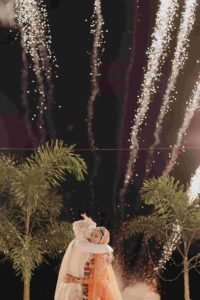
Our approach is not a template. Every Indian wedding in Thailand we cover is approached as a specific creative and documentary project. The ceremonies, the family dynamics, the regional traditions, the aesthetic vision — all of it informs how we plan, how we position ourselves during each function, and how we edit and deliver the final work.
We offer full-service media production: Photography and cinematic film from the same integrated team. This is not a bundling convenience. When both deliverables come from the same creative brief and the same production team, the photographs and film tell the same story. There is no friction, no misalignment, no day where the photographer and videographer are competing for the same moment.
Specifically for Indian weddings in Thailand:
- Multi-day programme coverage across all functions from Mehndi through Reception and beyond
- Second photographer and assistant as standard for multi-day and large-scale celebrations
- Cultural familiarity with Hindu, Sikh, Muslim and interfaith Indian ceremony formats
- Specific experience with North Indian, South Indian (Tamil, Telugu), Gujarati and Punjabi traditions
- Pre-wedding couple and location shoots at Thailand-specific settings
- Delivery of 2,000+ professionally edited images for multi-day programmes, with a cinematic highlight film of 12–20 minutes
Our Packages for Indian Weddings in Thailand
Everything is tailored. These are our starting frameworks around which we tailor your proposals for your big day:
Timeless
A beautifully focused experience for intimate, one-day celebrations. Thoughtful storytelling through stills and film, with creative direction that brings your vision to life. Perfect for couples who value simplicity, artistry, and meaningful moments captured with care.
Signature
More time, photos and moments, captured with intention and delivered with care. Designed for weddings that unfold over a day or more, it offers deeper coverage and creative direction for couples who want their story told in full.
Curated
More than just pictures; a layered narrative told through cinema, moments, and meaning. Crafted for multi-day celebrations, this is a complete creative experience where every event is woven into a timeless visual narrative. Perfect for luxury weddings and those who want significant detail and storytelling across multiple days, background and moments.
What Is The Cost of an Indian Wedding Photographer in Thailand?
1. Budget / Local Entry-Tier
This tier usually consists of talented local Thai photographers and suit an Intimate guest counts (under 50 people) or couples on a tight budget who are handling their own coordination.
- Cost:
THB: 65,000 to 110,000 THB
GBP: £1,450 to £2,500
2. Mid-Range / Professional Multi-Day Tier
This is the sweet spot for most couples. Photographers in this bracket have extensive portfolios specifically covering South Asian weddings. They understand the nuances of the baraat, the timing of the pheras and the chaotic energy of a Sangeet.
- Cost:
THB: 150,000–400,000+
GBP: £3,500–£9,300+
3. Destination Wedding Photography and Film
This tier features internationally acclaimed, award-winning destination wedding photographers (often flown in from India, the UK, or based in high-end studios in Bangkok). They provide premium, high-fashion and cinematic editorial coverage or custom portfolios with creative direction as we do at In The Fable Cameraworks.
- Cost:
THB: 350,000–800,000+ - GBP: £8,100–£18,600+
- Travel & Accommodation Fees: If the photographer is based in Bangkok but the wedding is in Phuket or Krabi, the couple is expected to cover flights and a 2–3 night hotel stay for the entire photography crew.
- Early Morning / Late Night Surcharges: Indian rituals (like a 4:00 AM Muhurtham or a reception afterparty running until 2:00 AM) may incur overtime fees if not negotiated upfront.
At In The Fable, we do not require flight, visa or stay charges due to our local team’s presence across Thailand.
Seeking an Indian wedding photographer in Thailand for your special day? Get in touch with our team at In The Fable Cameraworks for a personalised proposal for your special day.
Frequently Asked Questions (FAQs): Indian Wedding Photographer in Thailand
- Can you cover a multi-tradition celebration — for example, a Hindu ceremony and a Western reception?Yes, and it is some of the most interesting work we do. We have covered Hindu-Jewish, Tamil-North Indian, Indian-British and Indian-Australian celebrations where the ceremony draws from one tradition and the reception from another. The documentary approach works particularly well here as we find the real story of two families and two cultures in the same space, which is inherently richer material than a single-tradition event.
- Do you work with Indian wedding planners already operating in Thailand?Yes. We have working relationships with planners in Thailand and can make introductions. If you are coming with your own planner, we brief them on our production requirements early in the planning process so there are no surprises on the day.
- When should we book an Indian wedding photographer in Thailand?For peak season dates, book 9–18 months in advance.